Methane Hunting in Romania
Jan Selby – 29/06/2026
The week before last, I had the pleasure of going on my first methane detection fieldtrip, in the area around the city of Ploiești in southern Romania. The trip was coordinated by the wonderful Mihai Stoica of campaign group 2Celsius, with support from Theo Humann-Guilleminot, thermographer extraordinaire and methane hunter at the Clean Air Task Force. I was one of a dozen or so researchers, journalists, campaigners and artists joining Mihai and Theo on their annual tour of Romanian oil and gas facilities.
My aim, in joining Mihai and Theo, was simply to get a better and more grounded, practical understanding of oil and gas methane issues, to better inform the METHPOL project’s research priorities and methods. I’m relatively new to the technicalities of oil and gas production, as well as methane; hence much of what I learned – and what I say here – will be old hat to established methane experts. But four things particularly struck me.
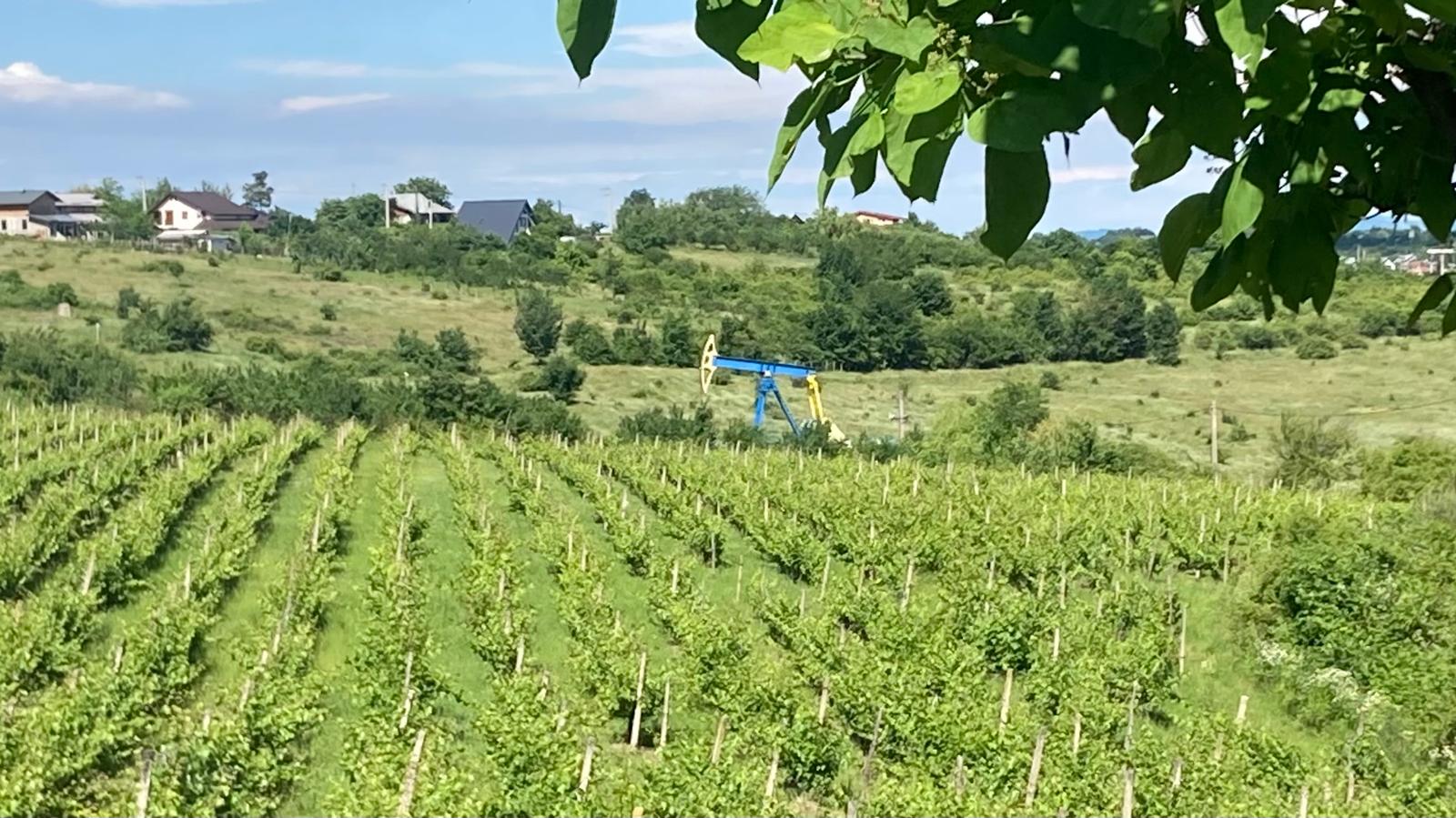
Vineyards and oil production above Ploiești.
The first was the simultaneous embeddedness and diversity of oil and gas facilities and methane emissions, across the many sites that we visited. We slept at a beautiful hotel in the foothills overlooking Ploiești, where Fidel Castro had once stayed whilst negotiating access to Romanian oil supplies. The area’s hillsides were covered with vineyards, and with a profusion of summer butterflies and wildflowers: roses, vetches, bedstraws, thyme, vipers bugloss, and more. But scattered amongst this beauty were scores of oil and gas wells, old and new, all with their associated gathering lines, separator tanks, storage tanks, valves and vent stacks.
Elsewhere, the geography of oil production was very different. We surveyed forests, driving up logging roads to find oil wells poking out of the trees. We visited urban areas, where oil facilities were just a stone’s throw away from houses or places of worship. We found everything from tiny, unprotected abandoned wells to major new facilities. We found cases of large-scale methane venting alongside scores of much smaller vents and leaks. And we saw just a tiny portion of the estimated 60,000–70,000 oil and gas wells that are found across Romania. Methane emissions abatement, it became apparent, involves tackling and before that understanding this incredible heterogeneity.

Oil wells in the town of Băicoi near Ploiești, with its church behind.
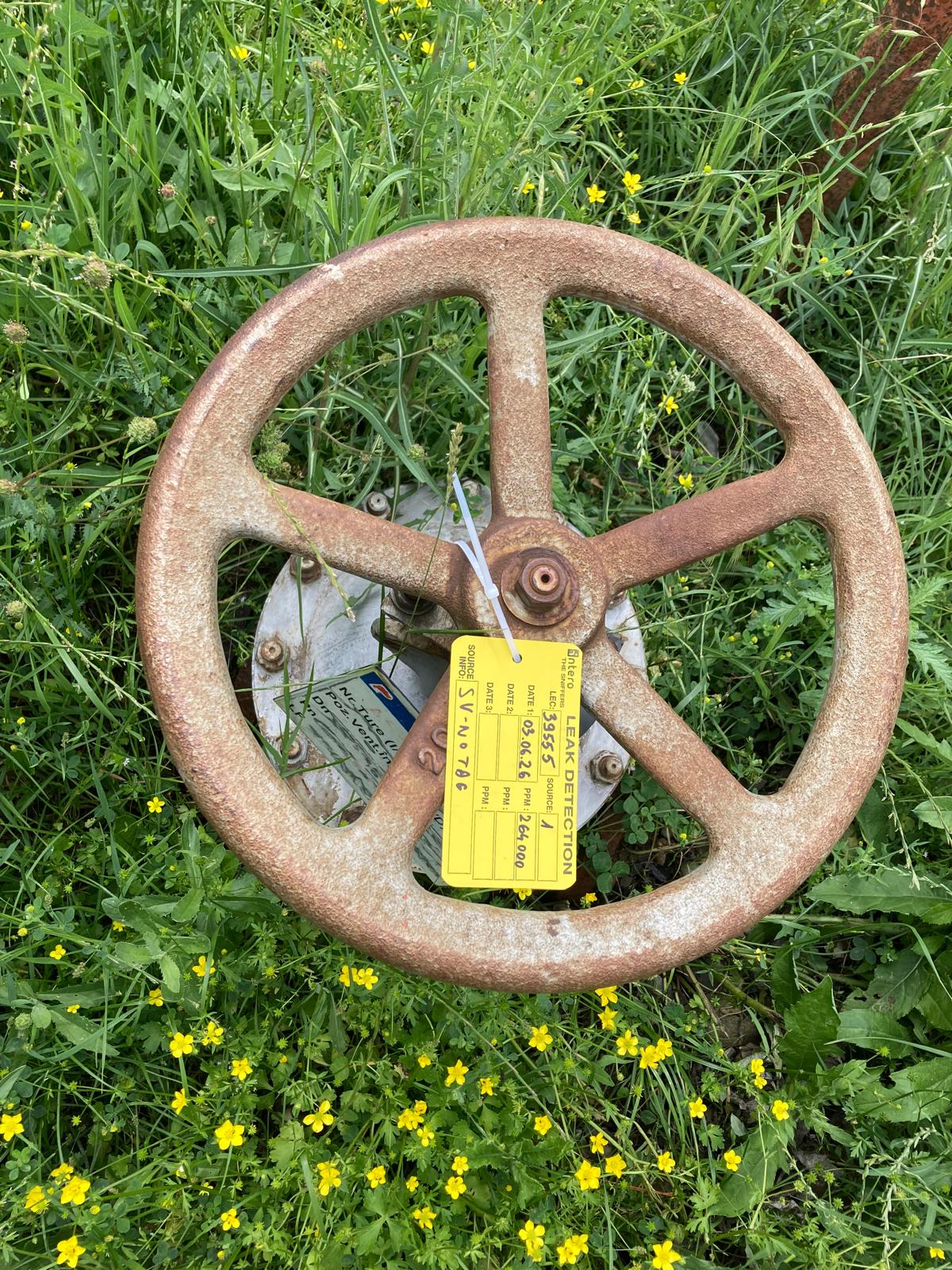
Tagging leaks under the EUMR, this one measured at 264,000 parts per million methane.
Second and more important, we found clear evidence that methane regulation can work. The EU’s 2024 Methane Regulation sets strict standards for leak detection and repair, flaring and venting, equipment, and more, and the fieldtrip provided opportunity to see and document its impacts. These were evident, first, in the form of yellow tags showing facilities where methane leaks had been identified by oil company engineers. But more than this was the evidence from the odd facility that we found that had been upgraded and modernised since Mihai and Theo last visited them – that is, since the EUMR came into effect. ‘This is the EUMR in action’, said Theo on several occasions.
The pattern was of course mixed. Many facilities showed no sign of attention at all. Many sparkling new storage and separator tanks had their hatches open, and were simply venting out gas as a matter of course. In other places, work done to patch up leaks was just moving the leaks to elsewhere from the same facility. Beyond this, the bigger picture is that Romania has still not legislated for a ‘competent authority’ to enforce the EUMR, as the Regulation requires. Yet for all this, there were clear signs of progress.
Third, what kept striking me was the centrality of visibility within methane politics. Methane, after all, is an invisible, odourless, leaky gas which is hard to locate and monitor, and which can only be made visible with the aid of sophisticated technology; methane is not a noxious pollutant that one can smell, and neither is it like CO2, produced as a straightforward biproduct of combustion. That’s why gas imaging and other means of monitoring and recording – by satellite, plane, drone and more – are so central to contemporary methane governance.
In turn issues of visibility seem to explain a lot about the pattern of methane emissions that we found. In vineyards and other accessible locations, the facilities were mostly well-kept and presented, with relatively small leaks. A site where Mihai and Theo had previously taken journalists had been thoroughly upgraded, with none of its five wells emitting methane at all. By contrast, deep in the forest we found few signs of the EUMR in action, and instead a profusion of rusted-up tanks and broken, venting pipes. Perhaps this is what one should expect for a problem that, before anything else is done, has to be rendered visible. But if so, then what are the chances for transformative methane abatement, especially when an Optical Gas Imaging (OGI) camera can cost $100,000, and when operating it requires technical experience and expertise?
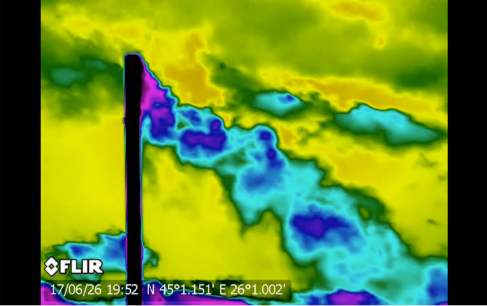
Significant venting from an open vent stack near
Ploiești, 17 June 2026. OGI image by Theo Humann-Guilleminot.
Last, though this wasn’t on Romania specifically, I kept thinking about the UK. For, as several of my fieldtrip compatriots commented, at least Romania now has methane regulation, even if it is still unevenly implemented and not yet enforced. The UK, by contrast, has nothing of the sort, having voluntary standards only and nothing equivalent to what is required by the EUMR. The UK is playing some valuable roles internationally on methane issues, including as co-chair of the Climate and Clean Air Coalition. It’s putting lots of its soft power behind this: last week, it hosted a methane and super-pollutant reception at St James’s Palace, attended by King Charles, the UN Secretary General and Barbados Prime Minister Mia Mottley. And maybe these diplomatic efforts will bear fruit: I hope so. But on the domestic front, the UK is clearly way behind Romania and its other European neighbours – and needs to start learning from them.